21.7.10

4500 Years Ago from 240 Miles Away at 2 Tons a Stone


The circle has been aligned to coincide with the midsummer sunrise and midwinter sunset.
 The southerly and northerly rising of the moon is also seen.


The architecture of Stonehenge has taken into account mathematical and geometrical considerations. The construction is structurally engineered to perfection.


Stonehenge is replete with a henge or ditch, and a bank. 
This surrounds the massive stone circle.


The stones of the structure are situated in such a way that they become larger in size at the center.
 The stones alternate between tall, thin stones and those stones with a tapering and obelisk shape.


Two varieties of stone were utilized for Stonehenge’s construction. The so called bluestones weighed nearly four tons. They were transported over a distance of 240 miles.


The second variety of stones included the ‘Sarsen’ stones, which weighed nearly 25 tons and stood at an impressive height of eighteen feet.


It is believed that more than 30 million hours of labor were spent in the construction work.


The construction of Stonehenge was completed between 3100 BC and 1100 BC.


Of the nine hundred stone rings present in the British Isles, Stonehenge is the most renowned

Ode to Jane Austen

This day trip we got to visit the home of Jane Austen.
Chawton Cottage lies in Hampshire, England about an hour and a half outside the city.
Transformed into a museum, we were able to go through and see what it would have looked like when Jane Austen lived there during the last 8 years of her life and well as some of her and her family's personal items.


Even before we made it into the house the garden was remarkable!


In the house we got to see her writing desk as well as her bedroom and the archives of the letters she kept.


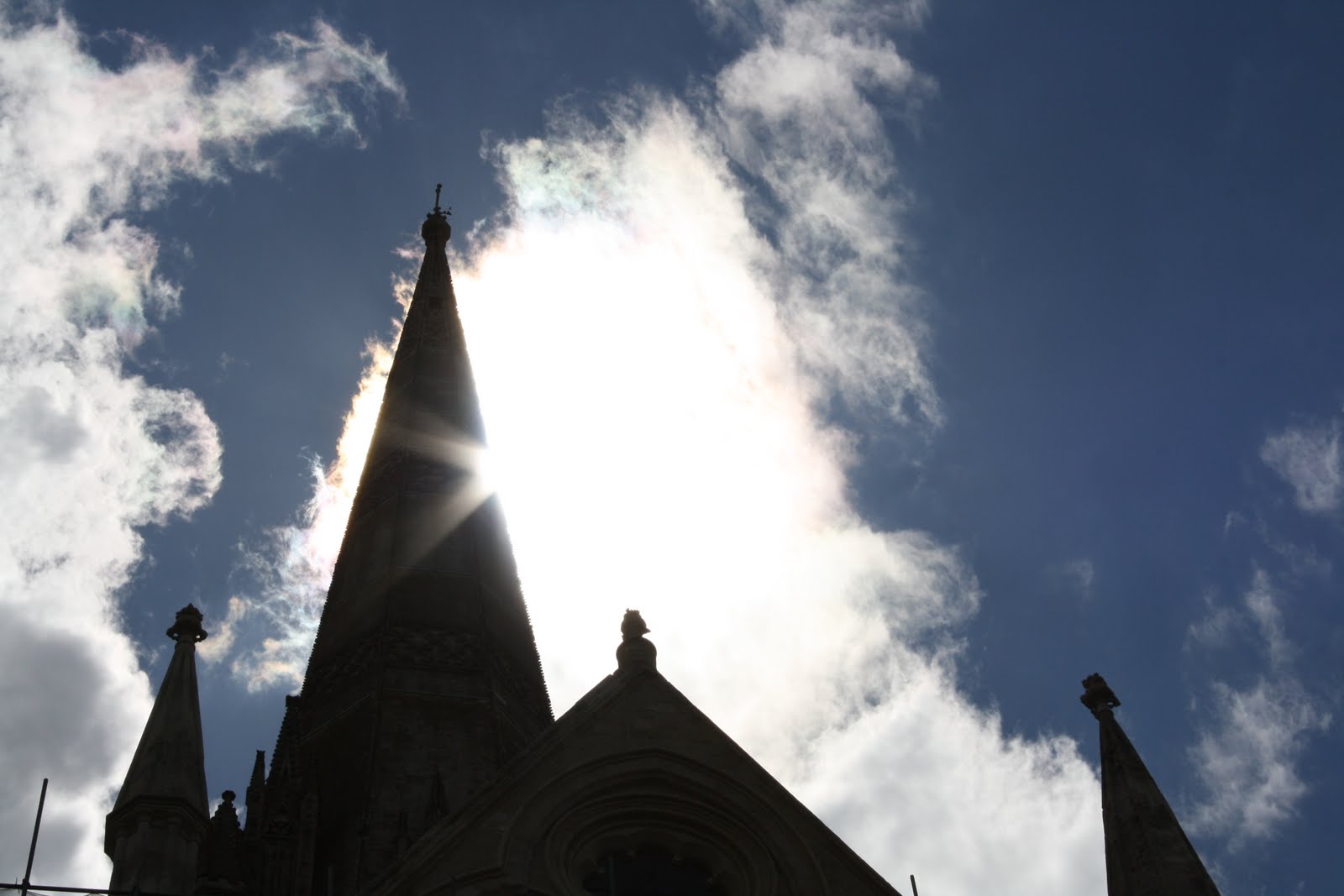
The Tallest Spire in all of Britain

Salisbury Cathedral


In addition to housing the tallest spire,
inside the cathedral held a beautiful reflection pool and an original Magna Carta!


Fun Facts

  • The Cathedral was built in just 38 years (AD1220-1258)
  • 60,000 tons of Chilmark Stone and 10,000 tons of Purbeck Stone were used to build the Cathedral
  • 28,000 tons of oak were used to construct the roof
  • 420 tons of lead covering 4 acres were used on the roof
  • Britain's tallest spire (123m/404ft) was built between AD1310-1333 adding another 6,500 tons
  • The spire now leans 69.85cm (27.5ins) to the south and 44.44cm (17.5ins) to the west
  • The best preserved of only four surviving original Magna Carta (AD1215) is on display in the Chapter House
  • Europe's oldest working clock (AD1386), now situated in the north nave aisle, used to be located in the Bell Tower (demolished in 1789). It has "ticked" more than 5 million times since it was first built
  • Salisbury has the largest Cathedral Close in Britain (40 hectares)
  • It has Britain's largest Cathedral Cloisters
  • The Quire stalls are the largest and earliest complete set in Britain
  • It is reputed that there are 365 (the number of days in a year) windows and 8760 (the number of hours in a year) marble pillars
  • The Close gates are locked from 10.30pm every night through until 7.00am next morning
  • The first Cathedral School was founded by Bishop Osmund in 1091 at Old Sarum - the original settlement site for Salisbury
  • Salisbury was the first Cathedral to have a girls' choir - founded in 1991
  • There are 69 statues on the West Front
  • A dead rat which carried traces of arsenic was found inside the skull of William Longespée when his tomb was opened centuries later

20.7.10

Ugh.


I don't have time to be sick.
 A wheezing cough, a pounding headache, a stuffy/runny nose, and waking up in the middle of the night with a fever and chills is not ok with me; I don't have time for it.
I tried to go to class today. Considering it's just downstairs I figured I'd be alright.
Nope.
After ten minutes of trying to pay attention my congested brain, dazed state of mind, and swimming head got the best of me.
My body felt like a lead weight as I gripped the railing and pulled myself back upstairs.
Everything ached.
I collapsed on my bed and laid there until 2:30. 

My stomach woke me up and told me that my two pieces of toast for breakfast wasn't cutting it.
I needed soup. And medicine.
So I got brave.
I loaded my pockets with tissues and decided to walk the couple blocks down to the grocery store. I wasn't sure if it was the best idea, but I was the only one in the centre, and I was hungry.
The noise of the city made my walk seem kind of surreal, but eventually I made it to Tesco without collapsing, being hit by a car, or being pick-pocketed in my dazed state.

Soup.
We don't have a stove.
I needed something microwavable.
I probably stared at the soup isle for a good 15 minutes.
Tesco had to have it. What good was a grocery store without Top Ramen? Or at least a Top Ramen equivalent. 
My staring was rewarded.
It looked promising.
So I grabbed three packs.
That was probably the best decision I made all day.

Medicine.
Extra strength cold and flu medicine is usually pretty expensive. I was expecting to pay 10 to 15 pounds for it. 
But to my surprise, all the medicine was dirt cheap! 
A bottle of Ibuprofen was 70 pence.
And my medicine was 1 pound 45.
Happiness.

I grabbed some bananas and moseyed home.
I ate my soup and took my medicine. And here I am,
 waiting for it to kick in.

That was my adventure for the day.

17.7.10

And back again.

Here in London we like to make use of our Saturdays.
Which mostly means MARKETS!
This particular Saturday our market of choice was Camden Market.
It was filled with an array of interesting foods, clothes, jewelery, and basically whatever else you can think of.


After our fun at the markets we remember that we're students too and we have homework.
Good thing it's fun homework!
We were told to visit the memorials at Hyde Park Corner.


The Royal Artillery Memorial


The Australian War Memorial

 Wellington Arch

16.7.10

Road Trippin,


On the long drive back home we made pit stops at various war memorials.
Our first stop was Le Grande Mine Crater at La Boiselle. This enormous crater was created druing the opening stages of the Battle of the Somme by tunneling under and exploding a huge quantity of explosives.

It's bigger than it looks.
Red poppies are often used to commemorate  those that died in war.
How perfect was it that the road leading up to La Boiselle was lines with wild red poppies.
It was beautiful.

Our next few stops were to various cemeteries.
Cemeteries almost lined the road. Some were large with many graves and other were small and fenced in with only a few. Many had names, others were only "Known unto God,"
and all were amongst beautiful flowers
and amongst each other.
Their bravery won't be forgotten.


15.7.10

Amiens

We left Paris
and drove in our Big 'ol coach to the cute little town of Amiens about two hours north of Paris.

Amiens is is a a place with flowers in every window and town bonding activities like movies in the town square. Their claim to fame is Amiens Cathedral.

We had to get our daily dose of course.


during the process of laser cleaning in the 1990s, it was discovered that the western façade of the cathedral was originally painted in multiple colors. A technique was perfected to determine the exact make-up of the colors as they were applied in the 13th century. Then elaborate lighting techniques were developed to project these colors directly on the façade with precision, recreating the polychromatic appearance of the 13th century. They project these lights along with a narration on summer nights and special occasions.
We came to Amiens at the perfect time.